There is a moment most people describe the same way. They are sitting in their apartment or their paid-off house, looking at a monthly budget that still feels tight, and they start doing the math on a different way to live. When the site rent comes back at $450 a month plus electric, they read it twice.
That is the moment that starts the conversation for most people who end up living full time in an RV community in Alabama. Not a crisis. Not a grand lifestyle manifesto. Just a spreadsheet that makes a number very clear.
But if you stop there — at the cost — you miss most of what makes permanent RV community life work. The cost is the reason people look. The community is the reason they stay. This guide covers both.
Why Alabama for Permanent RV Community Living

Alabama does not always make the first list when people research states for full-time RV living. Florida does. Texas does. Arizona does. Alabama tends to arrive later, when people start comparing actual monthly costs and stop comparing Instagram feeds.
Here is what Alabama has that most top-of-list states do not: genuinely affordable land, mild winters that do not require planning around, a culture that is unhurried and neighborly, and a geography that puts you within an hour of lakes, state parks, small cities, and a cost of living that is among the lowest in the country.
The state has no requirements around permanent RV living that are more complicated than other states. It has straightforward vehicle registration. It has low property taxes that apply to residents. It has a healthcare infrastructure that has expanded substantially in recent years, which matters for retirees. And it has room — unlike Florida and coastal Texas, where good RV park sites in desirable areas have waiting lists measured in years.
Central Alabama specifically — the corridor between Montgomery and Auburn — offers a particular combination: proximity to services and medical facilities without the density and cost of metro living. You can be at a major hospital within 40 minutes. You can also be on a quiet 54-acre property where the nearest neighbor is visible but not on top of you.
That combination does not exist everywhere. It takes deliberate searching to find it.
The Cost of Living: The Real Numbers
Let us put numbers on the page. The conversation about full-time RV living eventually has to get concrete. Here is what the monthly cost picture actually looks like for most residents at a park like Whispering Acres.
Site rent: $450/month. This includes water, sewer, trash, and shared amenities. It does not include electric or internet. Electric is metered separately and typically runs between $70 and $150 per month depending on season, RV insulation, and personal habits. Budget $520 to $600 for site rent plus typical electric.
RV payment or ownership: Highly variable. Many full timers arrive in paid-off units. Others carry a note of $200 to $500/month on a newer rig. Ownership matters more than age — a well-maintained 10-year-old unit with no payment is structurally less expensive than a new unit with a note, even if the new unit has nicer finishes.
Insurance: Full-time RV insurance through a specialty insurer typically runs $100 to $180 per month for a well-maintained coach. Standard auto insurance on the tow vehicle or truck is separate.
Food and household: Alabama’s grocery prices are roughly 8 to 12 percent below the national average depending on the category. If you cook regularly and shop at regional chains, a single person can eat well on $300 to $400 per month. A couple can manage $500 to $600.
$450/month site rent is $15 a day for your living space before metered electric. That is less than most people spend on lunch twice a week.
Add it up conservatively: site plus electric, insurance, food, and a $200/month miscellaneous line for fuel, repairs, subscriptions, and incidentals puts a single person’s full monthly cost of living at roughly $1,150 to $1,400 depending on vehicle ownership status. A couple with a shared RV and shared expenses can often manage $1,400 to $1,700 per month for everything.
Compare that to the median Alabama apartment at $1,100 just for rent — before utilities, renter’s insurance, and the rest. The math is not subtle.

Finding the Right Community
Not all RV parks are RV communities. This distinction matters more than any other single factor for people making the shift from occasional camping to permanent living.
A park is a place with hookups. A community is a place with neighbors who wave, who check on each other, who organize potlucks and fishing trips and share the name of a good mechanic. The difference is real and it is visible within about twenty minutes of arrival.
When you are evaluating parks for permanent living, these are the signals that tell you which kind of place you are looking at:
Long-term residents, not transients. Ask what percentage of residents are month-to-month or longer versus nightly and weekly. Parks built around long-term residents have different rhythms, quieter common areas, and more investment in maintenance. Parks built around transient occupancy feel like campgrounds because that is what they are.
Owner presence. Is the owner or manager on property regularly? Do residents know them by name? An absentee management structure at an RV park produces deferred maintenance, unresolved conflicts, and a sense that nobody is minding the place. Owner-operated parks with the owner on site are a different experience.
Resident reviews, not visitor reviews. Filter for reviews that mention months or years of residency. These are the accounts that tell you what life is actually like at the property, not what a weekend visitor thought of the bathhouse.
Site spacing and privacy. At 54 acres with a limited number of residents, Whispering Acres maintains site spacing that most parks — especially those that have maximized density — cannot offer. You can see your neighbors. You are not on top of them.
What breaks down and how fast it gets fixed. Ask current residents directly. Every park has infrastructure problems. The question is response time and attitude. One uncleaned bathhouse for two weeks tells you more than any amenities list.
Amenities That Matter for Full-Time Living

Amenity lists at RV parks are written for weekend guests. The things that matter for full-time living are different, and the difference is worth understanding before you sign a lease.
Internet. If you work remotely, manage finances online, stay connected to family by video, or stream entertainment, internet is infrastructure, not an amenity. Ask what the included connection actually delivers in practical terms during peak evening hours, not just the advertised speed. Ask whether residents have options to supplement with cellular if the park connection is unreliable.
Laundry. On-site laundry matters in ways that become obvious by week three of full-time living. The distance to the nearest laundromat, the cost per load, and the number of machines available relative to the number of residents all factor into daily quality of life.
Storm shelter. For full-time residents in Alabama, this is safety infrastructure, not a luxury. The question of where to go when tornado warnings are issued is answered or it is not. Whispering Acres has an EF-5 rated storm shelter. Most parks in Alabama have nothing equivalent.
Mail and package delivery. Establish your mail solution before you arrive. Most full timers use a mail forwarding service or establish a permanent address with a family member. Some parks offer a package receiving service or common mailing address. Confirm the logistics before they become a recurring inconvenience.
Outdoor space. A paid-off RV at a cramped, paved park with no green space is a different proposition than the same rig on 54 acres of natural terrain. The ability to sit outside, walk the grounds, fish a pond, or just exist in nature without driving somewhere first is a quality of life factor that compounds over months and years.
The Legal and Tax Picture
Full-time RV living raises genuine legal questions that are worth answering before you move, not after. None of them are unsolvable. All of them require a small amount of planning.
Domicile state. You need a legal domicile even if you live full time in an RV. For full timers who have chosen Alabama as their permanent location rather than traveling continuously, this is straightforward: establish your address in Alabama, register your vehicle in Alabama, and file your taxes as an Alabama resident. Alabama has no state income tax on social security income, which matters for retirees.
Vehicle registration. Alabama requires vehicles to be registered in the state if the owner is an Alabama resident. Registration is done through the county probate judge’s office. Fees are reasonable. For most people making the move from another state, this is a one-time errand in the first 30 days.
Health insurance. If you are under 65 and not covered by an employer, Alabama’s ACA marketplace options and short-term health insurance plans are available at various price points. If you are over 65, Medicare works in Alabama the same as any other state, with the same choices about supplement plans. The hospital and specialist infrastructure within driving distance of Tallassee is adequate for routine and specialty care.
Mail. Your legal address needs to receive mail reliably. Most Alabama-based full timers use their park address, a family member’s address, or a commercial mail forwarding service. The address you use should match your driver’s license, vehicle registration, and tax filings.
None of this is complicated. It is just a checklist that is better to run through before you arrive than to discover piece by piece afterward.
Seasonal Visitor vs. Permanent Resident: The Lifestyle Difference
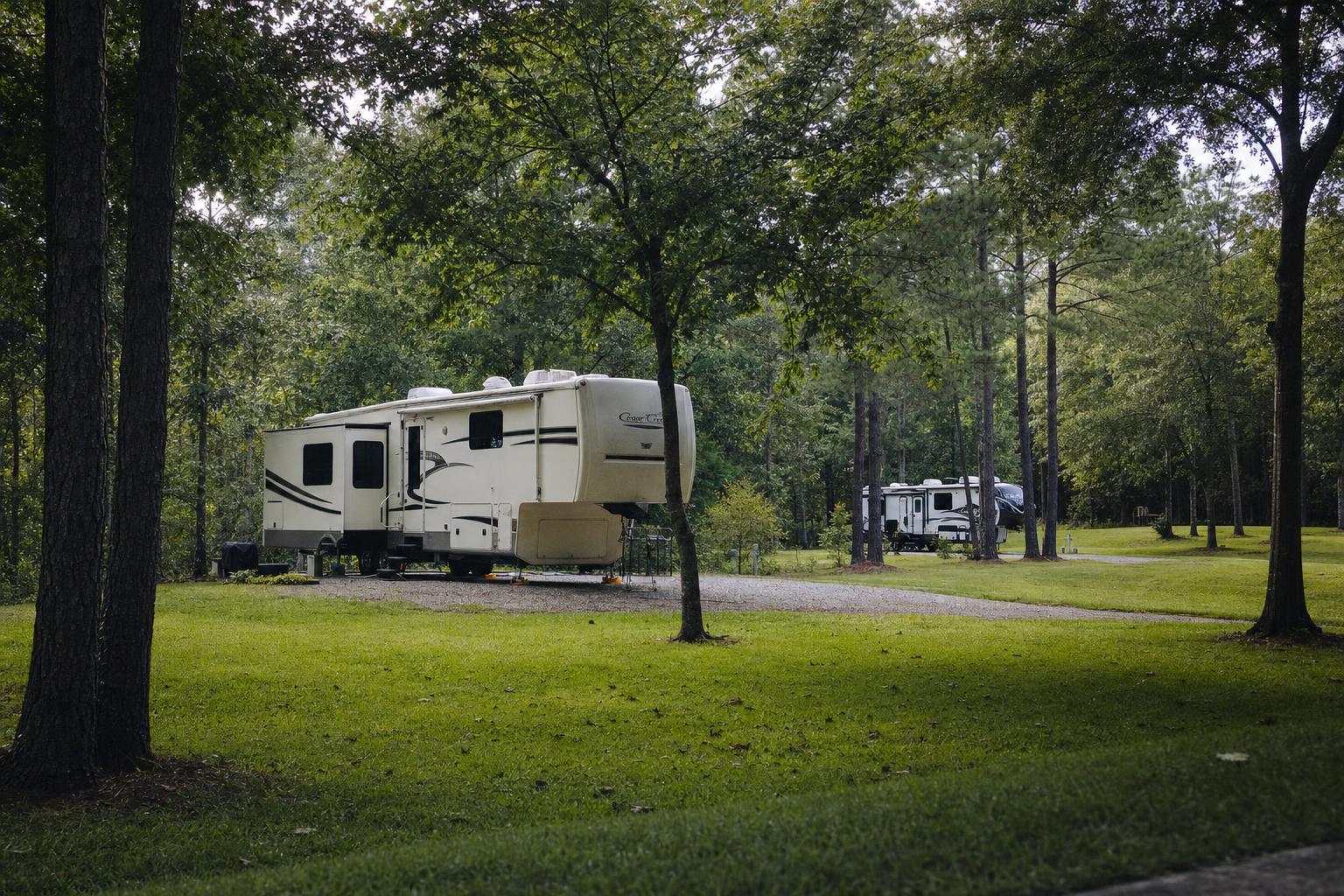
Alabama attracts both seasonal visitors and permanent residents at RV parks. The experience of each is different in ways that are worth understanding clearly.
Seasonal visitors arrive in October or November, spend the winter months in central Alabama’s milder climate, and leave by April. They come for the weather and the lower costs compared to their home state. They are pleasant neighbors for the months they are present. They do not invest in the community in the same way because they know they are leaving.
Permanent residents, or people who intend to stay year-round indefinitely, have a different relationship to the space. They plant things. They learn the names of people three sites over. They know which laundry machine to avoid and which fishing spot produces in April. They are there when someone needs help moving furniture or has a dead battery at 7 a.m.
The mix of seasonal and permanent residents at a well-managed park is generally healthy. Each brings something. The permanent residents create the culture; the seasonal visitors experience it.
If you are considering permanent living, be direct with the park owner about your intentions. Parks that are built around long-term residents will give you honest information about whether the community fits your goals. Parks that are primarily transient may accommodate a long-term resident but may not be built around that experience.
Whispering Acres is built around permanent residents. The EF-5 storm shelter, the site spacing, the owner-on-property management style — these are decisions made for people who are not just passing through.
Making the Move: A Practical Roadmap
The logistics of moving into full-time RV community living are less complicated than most people expect. Here is a straightforward sequence for people who have decided and are ready to act.
Step 1: Visit before you commit. A 30-minute tour of a park tells you more than a website and a phone call combined. You want to see the site you would occupy, walk the grounds, meet the manager or owner, and talk to at least one current resident if possible. Schedule a visit before you book a site.
Step 2: Nail down your RV situation first. Do not sign a lease before you have your unit. The reverse creates unnecessary pressure. Know what you are living in, know its mechanical condition, and know the cost before you commit to a site.
Step 3: Handle address and registration before or immediately after arrival. Your driver’s license, vehicle registration, and mail all need a consistent Alabama address within 30 days of establishing residency. Do this early and you will never think about it again.
Step 4: Give yourself 60 days before you evaluate. The first few weeks of any significant life change feel uncomfortable. The decision of whether full-time RV community living fits you is not a day-one determination. Give it 60 days. By then you will know whether you are at home or whether something needs to change.
Step 5: Tell the owner what you need. Permanent resident living is a relationship with the park operator, not just a transaction. If something is not working, say so. Good owner-operators would rather hear about a problem and fix it than lose a long-term resident.
Real Stories: Why People Choose Alabama Permanent Community Life
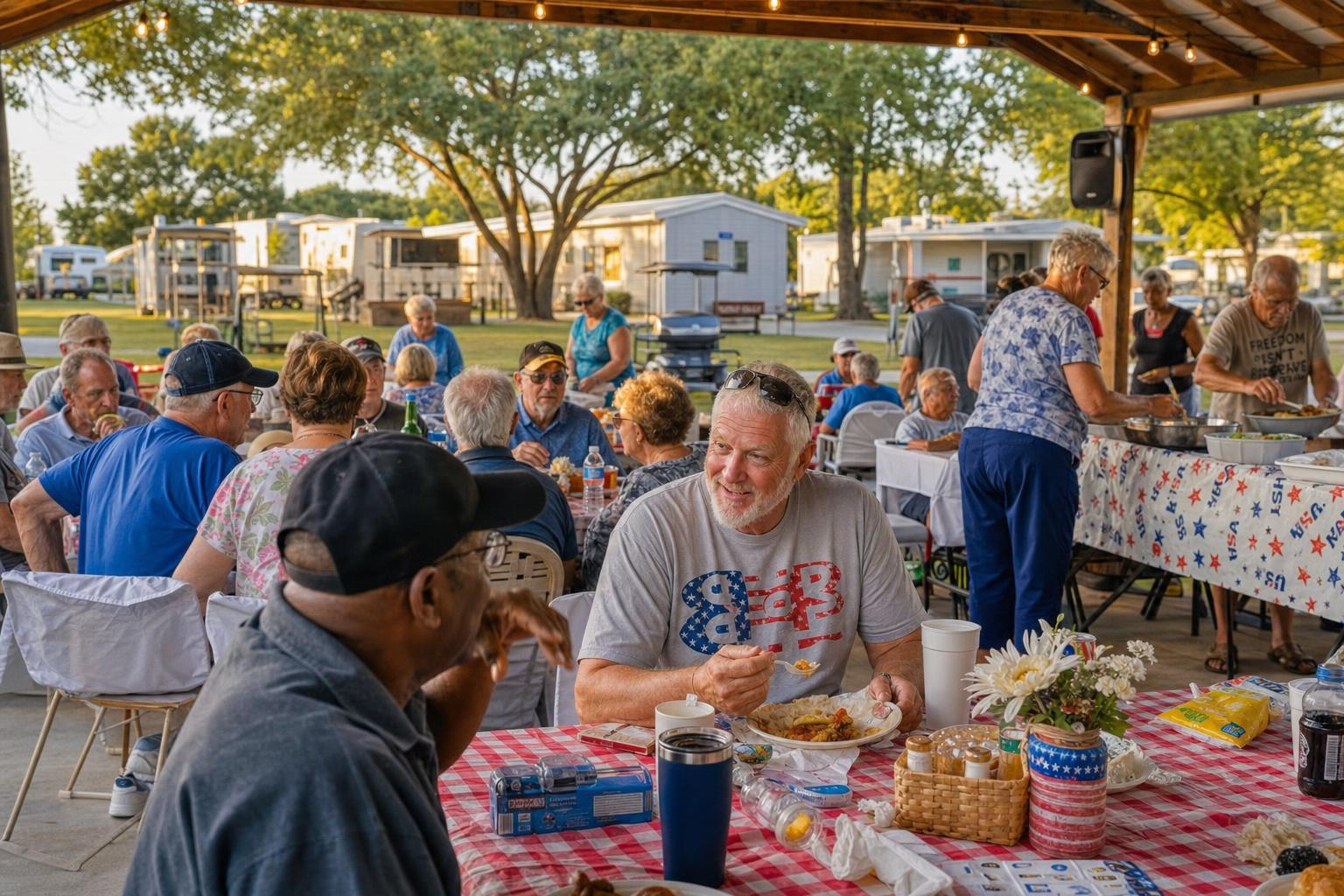
The pattern at Whispering Acres is consistent enough to be worth describing directly.
Most residents arrived thinking about the money. They were paying $1,100 or $1,400 a month in rent somewhere — an apartment, a house, a place that felt fine but left them stretched. Someone mentioned long-term RV living. They looked it up. They found the numbers. They scheduled a visit.
And then, somewhere around month three or four, they stopped talking about the savings.
They came for the cost savings and stayed for the people.
What residents describe when you talk to them long-term is not primarily financial. It is about pace. The morning coffee outside. The neighbor who stopped by. The fishing in the evening. The absence of the particular stress that comes from paying more than you should for a place that does not feel like yours.
Some are retirees who spent decades in houses and wanted less. The maintenance, the property taxes, the rooms they never used — they traded all of it for 54 acres where they own their unit, pay $450 a month for the site, and pay electric based on actual usage.
Some are working-age people who do not need to be tied to a city anymore. The commute is gone. The lease on an expensive apartment is gone. What remains is a community, a schedule they control, and a monthly cost that leaves room for the things they actually want.
Some came for the winter and never left. Alabama’s winters are mild enough that the logic of going back north stops making sense when the people you know are here and the costs are this much lower.
The Real Cost of Not Making a Change
Most people who end up at a place like Whispering Acres waited longer than they wish they had. The inertia of existing arrangements is powerful. You know your current costs. You do not fully know your future ones. Change requires energy. Staying requires none.
But staying has a cost too. If you are paying $1,200 per month in rent and the alternative is $550 total, the difference is $650 per month. Over a year, that is $7,800. Over five years, that is $39,000.
That is money that either goes somewhere useful or disappears into a lease. The decision is yours and the timeline is yours. But it is worth putting those numbers on the page at least once, clearly, so that the cost of inaction is as visible as the cost of change.
The question is not really whether you can afford to make the move. For most people doing the math, the question is whether you can afford to keep not making it.
How to Take Your First Step
If you have read this far, the idea is serious enough to act on. The first step is a conversation and a visit — no commitment required, no deposit, no obligation.
Call or text Whispering Acres at (334) 725-6121. Email at info@whisperingacresofalabama.com. Schedule a time to walk the property, see available sites, and ask every question on your list.
The answers to most of those questions are better in person than over the phone. Come see the storm shelter. Come see the site spacing. Come see why 27 five-star reviews from actual residents all land on the same words: safe, peaceful, felt like home.
That first visit is the whole first step.
Ready to See It for Yourself?
Schedule a tour of Whispering Acres. No obligation, no pressure — just a walk around 54 acres and answers to every question you have.
Schedule a Tour →